
Ecology & EnvironmentGrades 7–8
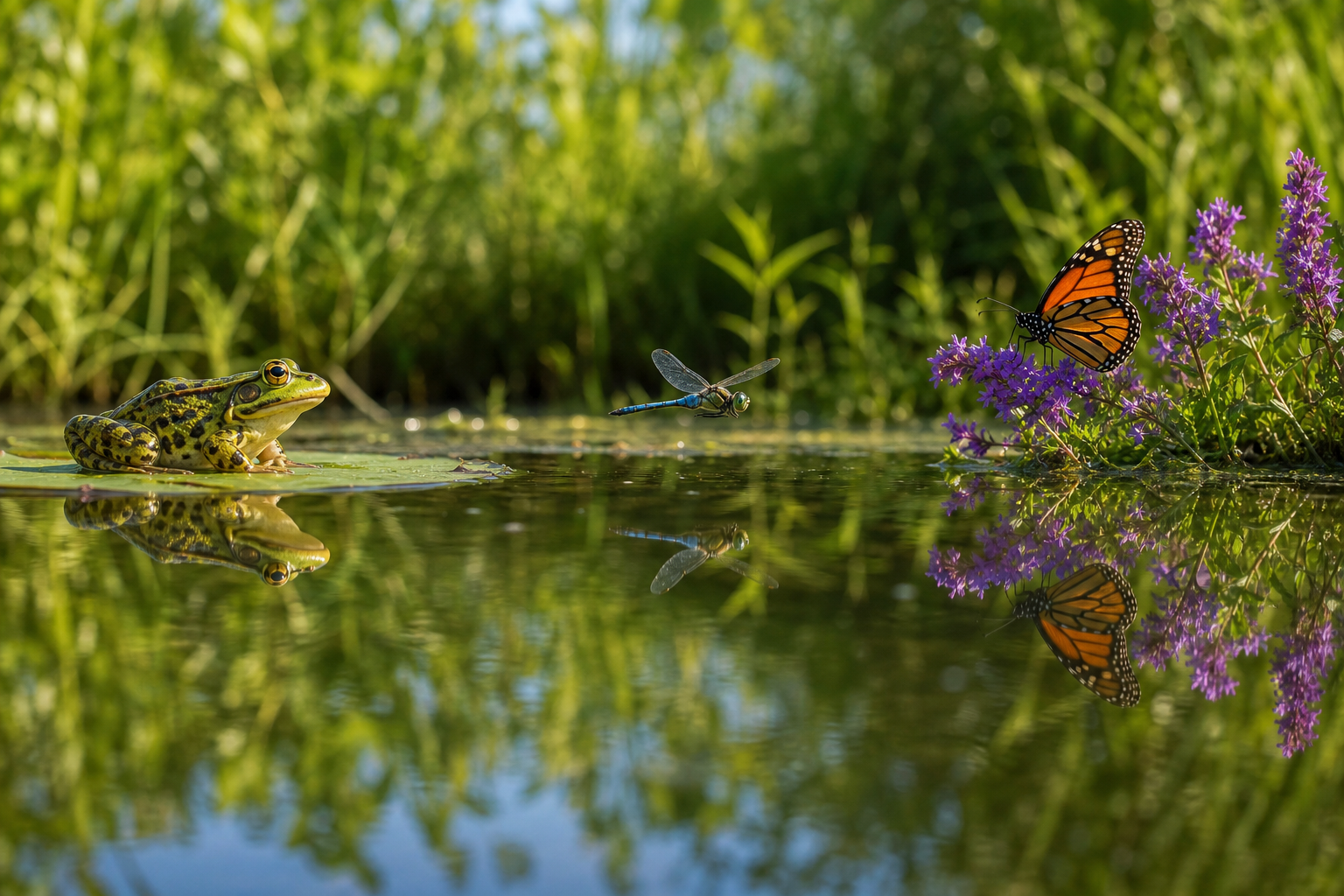
Biodiversity
How species interact – and what breaks down when they disappear.

Open Educational Resources
52 interactive learning modules on the 17 Sustainable Development Goals (SDGs) of the 2030 Agenda. Immersive 360° experiences — directly in the browser.
Supported by
Module Structure
Each module is compact enough to fit into a single lesson.
All texts are available as audio narration and in written form.
Every module can be used via the accessible player.
Consistent structure of 360° scenes and supplementary slideshows.
Five quiz questions at the end of each module for learning assessment.
The last scene offers extension material for advanced learners.
Hardware-independent use
The catalog contains 46 planned modules. 15 of them are temporarily available online for preview.
Download the module Biodiversity as a sample:
How species interact – and what breaks down when they disappear.

How fishing fleets alter food webs – and what marine reserves can achieve.

How much CO₂ is hidden in food – and which diet protects the climate.

How climate change amplifies health risks – and what adaptation strategies help.

How oil enters the ocean – and what consequences it has for coasts and marine life.

How ecosystems buffer climate impacts – and where nature-based approaches reach their limits.

How community gardens in cities create habitat for species – and improve the urban climate.

How production chains make water invisible – and what quantities hide behind everyday products.

How deforestation destabilises climate and habitats – and what protection approaches exist.

How climate change and usage intensify water scarcity – and which regions are hit hardest.

What threats put forests under pressure – and how reforestation and forestry secure their future.

Where e-waste from industrialised countries is exported – and what consequences it has in the Global South. (Focus: export chain and destination conditions)

How large the e-waste problem is – and what more sustainable pathways exist. (Focus: pollutants, recycling and repair in the life cycle)

How the circular economy changes career profiles – and which green jobs emerge.

How circular economy can change the throwaway society – from upcycling to waste prevention.

How much food is thrown away – and where along the supply chain the largest losses occur.

How poverty and wealth sit side by side in cities – and what more equitable urban development can achieve.

Who has access to education – and what happens when that access is missing.

Which principles sustain democracy – and how young people can participate.

What forms discrimination takes – and how to counter it.

Where gender determines opportunities – and what equality can achieve.

Why children are forced to work – and which rights protect them.

Why climate change displaces people – and international law has no answer.

Where human rights apply, where they are violated – and who bears responsibility.

Why people flee, what the journey looks like – and what arrival means.

Who has access to water, who does not – and why this is a question of justice.

What Fairtrade achieves, where labels reach their limits – and what fair trade needs.

How products get from raw material source to shelf – and what consequences the chain has.

How purchasing decisions affect global supply chains – and what the SDGs set against it.

Why states must cooperate – and what makes multilateral agreements fail.

How mass tourism transforms places – and what alternatives sustainable travel offers.

What is inside smartphones – and under what conditions the raw materials are mined.

How automation changes career profiles – and who benefits or loses.

How data analysis can transform climate and resource management – and where the limits lie.

What digital traces arise in everyday life – and how personal data can be protected.

Where digitalisation improves education – and where it creates new inequalities.

Why every line of code costs energy – and how software can become more sustainable.

How connected devices are changing everyday life and industry – between efficiency and data protection.

How AI makes decisions – and why transparency and responsibility are indispensable.

How AI can evaluate climate data, optimise energy grids and predict extreme events – and where the technology itself becomes an emitter.

Why the digital world consumes energy, water and raw materials – and what more sustainable IT can look like.

How today's decisions on agriculture, energy and urban planning determine quality of life in 2050.

How solar, wind and water replace fossil energy – and what challenges the energy transition brings.

How green infrastructure and sustainable mobility make cities more climate- and people-friendly.

How sensor networks and data platforms control cities – and what risks for data protection and participation arise.

Why energy access enables development – and how decentralised solutions make the difference.

Where water is hidden everywhere – and why you don't see it.

Why swimming is more than sport – and when water becomes dangerous.

How the forest stores rain – and what happens when it's gone.

The long journey of a water droplet – from cloud to glass.

What happens when it rains too much – and how cities prepare.

How litter travels from the school yard to the river – and what can be done.
For Foundations & Sponsors
OER Model
A foundation adopts a learning module and makes it permanently free for schools to use — on tablets, computers, interactive whiteboards and VR headsets.
For €5,000 a module is finalised and published as OER — with visible credit as a supporter.
Visually and linguistically immersive, didactically sound — a module that brings the funded topic to life. Online and offline in the free VR-Suite player.
All materials can be fully downloaded, freely used, adapted and published anywhere. The present4D server only enables simple, free distribution.
All modules are prepared to a high content and didactic standard and address specific Sustainable Development Goals (SDGs). Upon adoption we give each module a final polish — imagery, 360° scenes and details.
For Teachers
Since all modules follow the same compact basic structure, the decisive question is the content fit and the specific learning value of VR for that topic.
All modules follow the same compact format and are therefore easy to place in existing lesson sequences.
The key question is not whether VR looks impressive, but where a spatially coherent 360° experience helps learners understand relationships more clearly than flat media.
Learning goals, SDGs and school relevance can be checked directly at the module level.
For the 'Why VR?' check, we focus above all on whether a module offers a real medium-specific advantage over textbook, worksheet or video. That benefit can already emerge in a browser-based 360° tour; the headset mainly increases immersion.
SDG-Icons: © United Nations. un.org/sustainabledevelopment. The content of this publication has not been approved by the United Nations and does not reflect the views of the United Nations or its officials or Member States.